Home » Blogs » When the Strait Tightens, the Cold Chain Breaks Silently
When the Strait Tightens, the Cold Chain Breaks Silently

When the Strait Tightens, the Cold Chain Breaks Silently

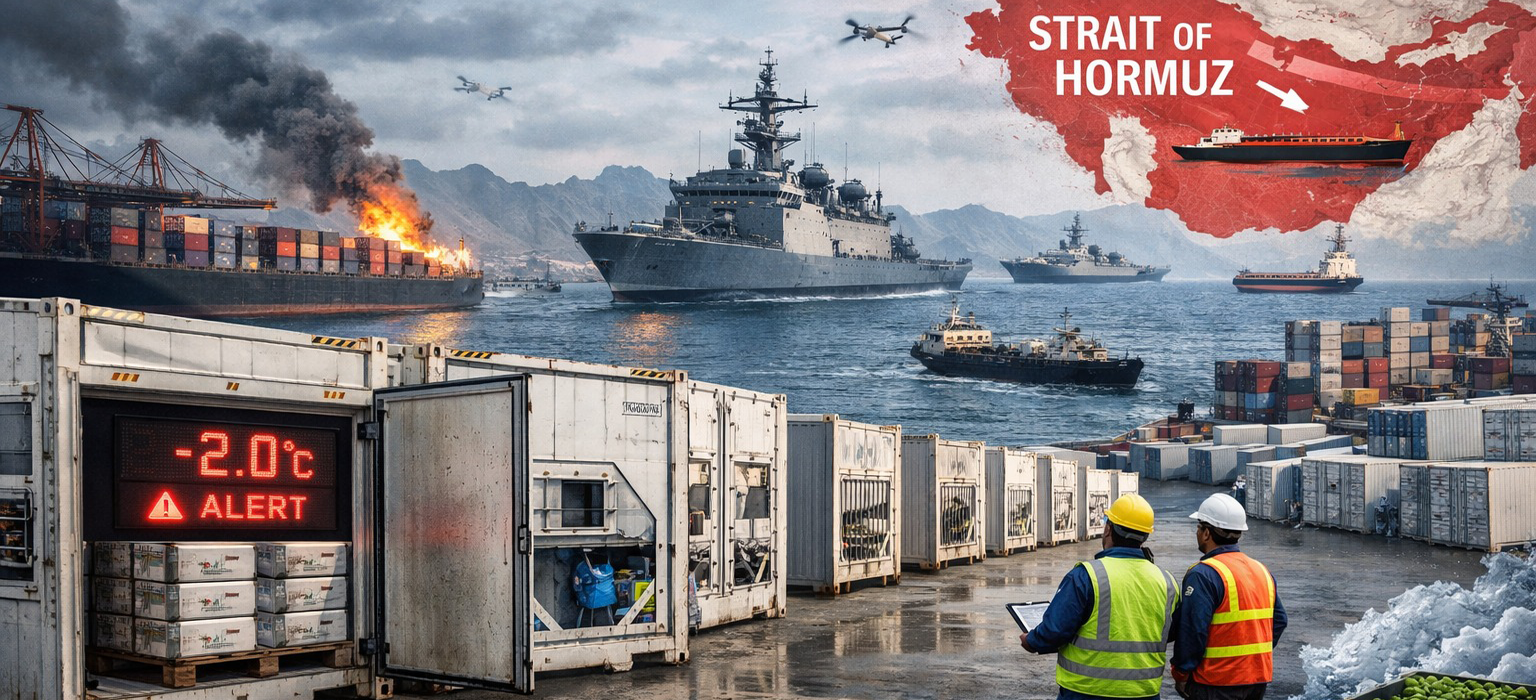
In global trade, disruptions don’t always arrive with noise. Sometimes, they arrive quietly — as delays, as temperature deviations, as “just 2 extra days.” And right now, the world is standing at one such fragile point. With rising geopolitical tensions around the Strait of Hormuz, most discussions are focused on oil. Tankers. Fuel prices. Energy markets. But there’s a less visible, more sensitive system under pressure: The cold chain.

The Strait of Hormuz: Not Just an Oil Route

Nearly 20% of the world’s oil passes through the Strait of Hormuz. But alongside it moves something far more fragile:
Unlike oil, these products don’t just lose value when delayed —  they expire, degrade, or become unusable.
A delay in crude oil impacts pricing. A delay in cold chain impacts product integrity.
The Hidden Risk: Time is Temperature

In cold chain logistics, time is not just money.
Time = Temperature Stability
Even the most advanced reefer container has limits:
When vessels slow down, reroute, or wait at ports due to geopolitical uncertainty:
And most importantly: Every additional hour increases the probability of product loss.

The Gulf Region Bottleneck Effect

The Gulf acts as a major redistribution hub for temperature-sensitive cargo.
The result? A silent supply chain imbalance.

What Most Businesses Are Missing

Most companies prepare for price fluctuations. Few prepare for cold chain disruptions. And that’s where the real risk lies. Because when reefer containers get stuck:
In industries like pharma and food, this is not just a financial loss — it’s a credibility risk.

The Shift: From Reactive to Prepared Cold Chain

This situation is a wake-up call.
Forward-looking businesses are already adapting:
Because in today’s world: Cold chain resilience is no longer optional — it is strategic.

A Different Way to Think About Risk

The biggest mistake companies make is assuming: “Delays will happen, but we’ll manage.” But cold chain doesn’t work like traditional logistics. You don’t manage delays — you engineer resilience before delays happen.

Conclusion: The Silent Crisis Few Are Talking About

While headlines focus on oil tankers and naval movements, a quieter crisis is building beneath the surface.
The Strait of Hormuz may or may not close.But the lesson is already clear: In an uncertain world, the strongest supply chains will not be the fastest — they will be the most prepared.

Partner with Crystal Group

The goal is no longer just cold storage, it’s a smart, sustainable, optimized cold chain for a growing India. 

Contact Us

We will get back to you within 24 hours.

Please enable JavaScript in your browser to complete this form.