Home » Blogs » The Ice Cream Test: What Those Crystals on Your Kulfi Are Actually Telling You
The Ice Cream Test: What Those Crystals on Your Kulfi Are Actually Telling You

The Ice Cream Test: What Those Crystals on Your Kulfi Are Actually Telling You

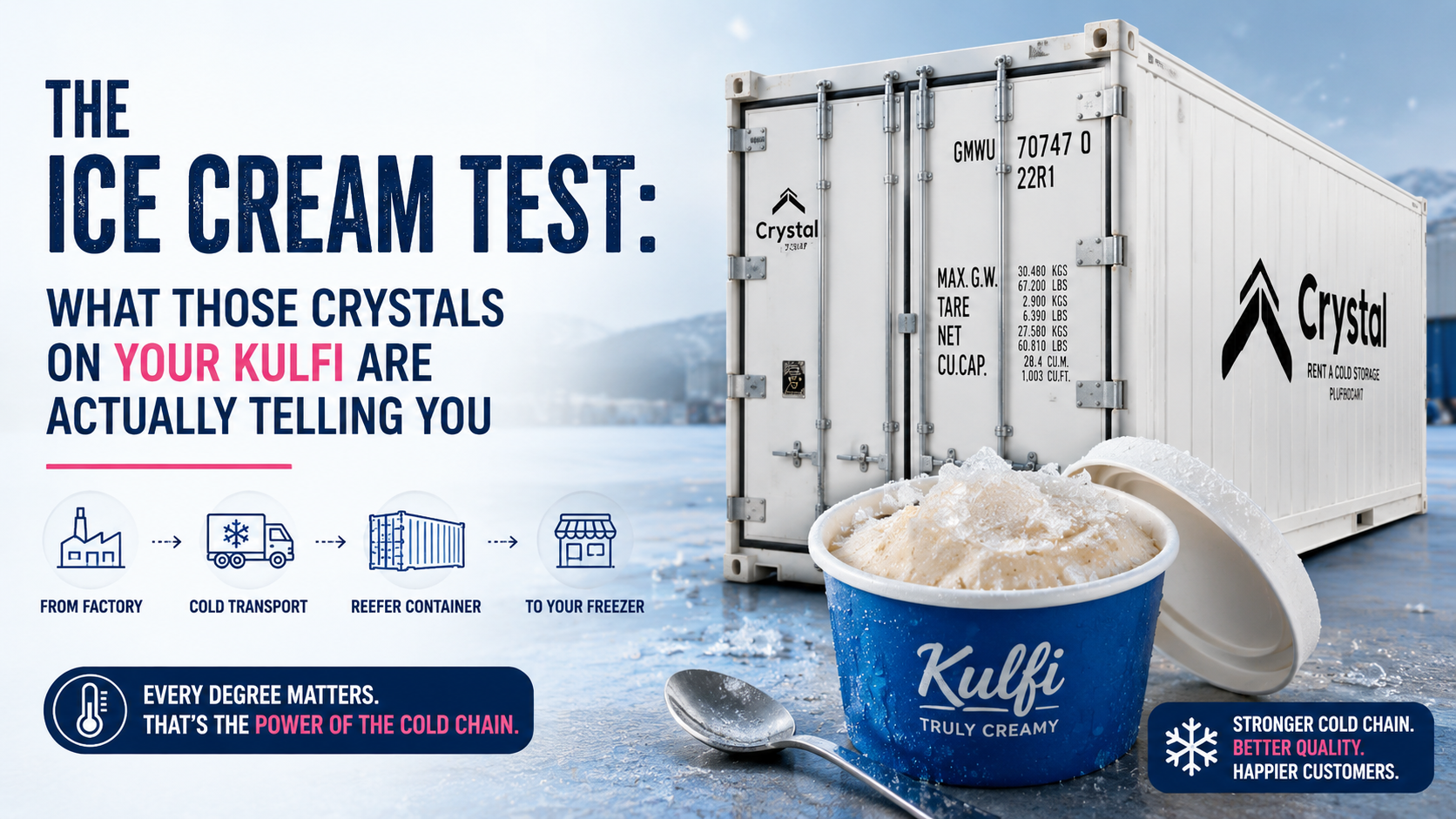
You bought a tub of ice cream from the shop downstairs. You brought it home, put it in the freezer, and opened it two days later. There is a layer of ice on top. The texture feels gritty and crunchy. The scoop doesn’t glide the way it normally does. You might simply think: “This ice cream has gone bad.” But those crystals could be telling you something much more interesting. They may be telling the story of what happened to your ice cream before it reached your freezer.

What Are Those Crystals?

Ice cream is mostly water, fat, sugar and air, carefully combined and frozen to create a smooth texture. When it is manufactured and frozen correctly, the ice crystals are extremely small. That’s one of the reasons good ice cream feels creamy rather than icy. The problem starts when the temperature changes. When ice cream warms up, some of its ice crystals begin to melt. When it freezes again, that water refreezes and the crystals can become larger.
Repeated warming and refreezing can create the gritty, icy texture you notice on the surface. The industry refers to this kind of temperature abuse as heat shock. And here’s the important part: The ice cream doesn’t necessarily leave the factory like this. It can happen somewhere along the journey.

The Cold Chain Is a Journey

Think about everything that happens between the factory and your freezer.
Manufacturing → Cold Storage → Transportation → Distribution → Retail → Your Home
At every stage, the product needs to remain within its required temperature range. The factory can manufacture the perfect product. The cold-storage facility can store it correctly. The transportation team can move it under controlled conditions. But if the temperature is not maintained during one of the handovers, the product can begin losing quality. This is why cold-chain logistics is not simply about “keeping something cold.” It is about maintaining the right conditions consistently throughout the journey.

Where Can Things Go Wrong?

Temperature fluctuations can happen at several points

This Is Where Reefer Containers Become Important

A reefer container is a refrigerated container designed to maintain controlled temperatures for temperature-sensitive products during transportation and storage. But its value goes beyond simply moving frozen products from one location to another. A reefer can also provide flexible, temperature-controlled storage capacity when and where a business needs it.
Imagine a food manufacturer suddenly needs additional freezer space. Or a distributor is facing seasonal demand. Or a warehouse is operating at full capacity. Or a business needs temporary cold storage while expanding its permanent facility. Instead of allowing temperature-sensitive inventory to wait in uncontrolled conditions, reefer containers can provide an additional controlled environment. They can be deployed at manufacturing facilities, distribution centres, retail hubs and other locations where additional temperature-controlled capacity is required.
In other words, a reefer can become an extension of your cold-storage infrastructure.

It's Not Just About Frozen Food

Ice cream makes temperature problems easy to understand because you can often see the damage. But many temperature-sensitive products don’t give you such an obvious warning.
Think about:
A temperature deviation can affect different products in different ways. It may reduce shelf life. It may affect texture, taste or appearance. It may accelerate product deterioration. And in some highly temperature-sensitive industries, maintaining specified conditions can be critical to product integrity. That is why temperature-controlled logistics is not simply a transportation function.
It is part of protecting the product itself.

The Last Mile Matters More Than We Think

Most people imagine the cold chain as a long refrigerated truck travelling from one city to another. But the journey doesn’t end when the truck reaches the distribution centre. The product still has to reach the local hub, retailer and eventually the consumer.
The closer the product gets to the customer, the more frequently it may be handled. More transfers. More door openings. Smaller storage units. More loading and unloading. More opportunities for temperature fluctuations. This makes the last mile one of the most important parts of the cold chain.
And as quick commerce, organised retail, food delivery and decentralised distribution continue to grow, businesses increasingly need cold-storage capacity closer to the point of demand. Flexible solutions such as reefer containers can help bridge that gap.

Cold Chain Is About Consistency

A common misconception is that cold-chain logistics means making a product extremely cold. That’s not necessarily the goal. The goal is to maintain the required temperature consistently. Different products have different requirements. What matters is that the product remains within the appropriate conditions throughout its journey.
When these work together, the product that reaches the customer is much more likely to remain in the condition in which it was manufactured.

From Factory to Freezer

Factory → Cold Storage → Reefer → Distribution → Retail → Home Freezer
Every link matters. Because a cold chain is not successful simply because the product arrived.It is successful when the product arrives in the condition it was supposed to be in. That is the real value of temperature-controlled logistics.

So, What Are Those Ice Crystals Really Telling You?

The next time you open a tub of ice cream and find a layer of ice on top, don’t just ask:
“Why is my ice cream icy?”
Ask:
“What happened to the temperature along the way?”
Those crystals may be a small visible sign of a much bigger supply-chain problem. Behind every perfectly smooth tub of ice cream is a cold chain working quietly in the background.
Refrigerated vehicles.
Cold-storage facilities.
Reefer containers.
Temperature monitoring.
Distribution networks.
People making sure the required conditions are maintained—even when nobody is watching.
At Crystal Group, we have been building India’s cold-chain ecosystem since 1962, providing solutions including reefer containers, cold-storage infrastructure and temperature-controlled logistics to help businesses protect temperature-sensitive products across their journey. Because when the cold chain works properly, nothing dramatic happens. The ice cream stays smooth. The milk stays fresh. The frozen food stays frozen. The product reaches the customer the way it was meant to. In cold-chain logistics, nothing happening is the entire point.

Partner with Crystal Group

The goal is no longer just cold storage, it’s a smart, sustainable, optimized cold chain for a growing India.

Contact Us

We will get back to you within 24 hours.

Please enable JavaScript in your browser to complete this form.